
Canon 40D Camera Manual: A Comprehensive Guide
Welcome! This detailed manual unlocks the full potential of your Canon 40D, offering essential guidance and advanced techniques for stunning photography.
Explore tips, tricks, and a thorough understanding of all features, ensuring you maximize performance and capture incredible images with your new camera.
Begin your photographic journey today with this comprehensive resource, designed to help you master every aspect of the Canon 40D’s capabilities.
Welcome to the world of the Canon 40D! This digital SLR camera represents a significant step into the realm of professional-quality photography, offering a powerful blend of performance, features, and user-friendly operation. This introduction serves as your starting point, guiding you through the initial setup and familiarizing you with the core functionalities of your new camera.
The Canon 40D is designed for both enthusiasts and professionals seeking a versatile tool capable of capturing stunning images in a variety of shooting conditions. Whether you’re a beginner eager to learn the fundamentals or an experienced photographer looking to expand your creative horizons, this camera provides the tools you need to succeed.
Before diving into the detailed sections of this manual, take a moment to appreciate the robust build quality and intuitive design of the 40D. This guide will empower you to unlock its full potential, transforming your photographic vision into reality. Get ready to explore and create!
Understanding the Camera Body & Controls
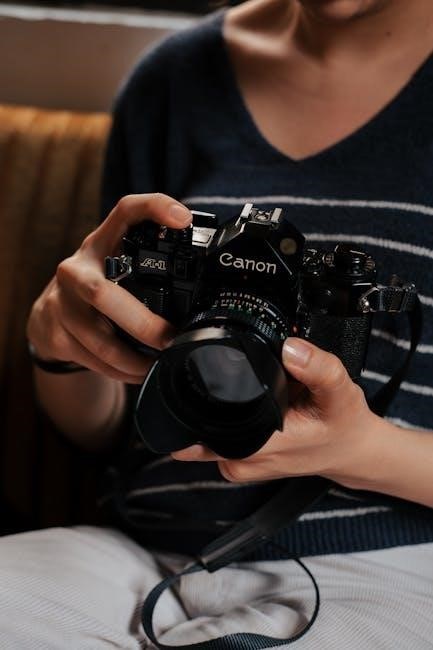
Familiarizing yourself with the Canon 40D’s physical layout is crucial for efficient operation. The camera body is designed for comfortable handling and intuitive control, allowing you to quickly adjust settings without taking your eye off the subject. Key elements include the mode dial, offering access to various shooting modes like Auto, Program, Aperture Priority, and Manual.
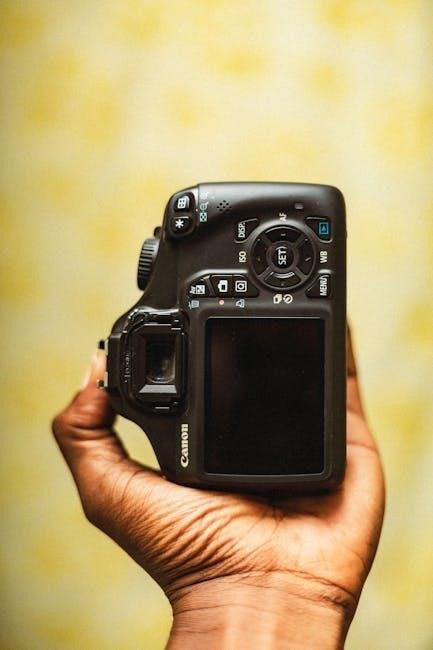
The rear panel houses the LCD screen for image review and menu navigation, alongside essential buttons for playback, menu access, and shooting settings. The directional buttons and Set button facilitate easy menu traversal. Pay attention to the Quick Control dial, enabling swift adjustments to aperture, shutter speed, and ISO.
Understanding the placement and function of each control will significantly enhance your shooting experience, allowing for seamless transitions between settings and maximizing your creative control. Take time to explore and practice!
Key Features and Specifications
Discover the Canon 40D’s powerful capabilities! This camera boasts a robust feature set, delivering exceptional image quality and performance for both amateur and professional photographers.
Sensor and Image Processor
At the heart of the Canon 40D lies a remarkable 10.1-megapixel APS-C CMOS sensor, delivering exceptional detail and clarity in every image. This sensor size strikes a balance between image quality and camera body size, making it versatile for various shooting scenarios.
Paired with the DIGIC 3 Image Processor, the 40D achieves rapid image processing speeds, enabling quick continuous shooting and responsive camera operation. The DIGIC 3 processor also contributes to excellent noise reduction, resulting in cleaner images even at higher ISO settings.
This combination ensures accurate color reproduction, wide dynamic range, and overall superior image quality. The sensor and processor work harmoniously to capture stunning photographs with minimal noise and maximum detail, making the Canon 40D a capable imaging tool.
Experience the difference a quality sensor and processor can make!
Megapixel Count and Image Quality
The Canon 40D boasts a 10.1-megapixel sensor, a resolution considered excellent for its time, providing ample detail for prints up to a considerable size and sufficient data for cropping without significant quality loss. While megapixel count isn’t everything, it plays a crucial role in overall image clarity.
Image quality is further enhanced by the sensor’s design and the DIGIC 3 processor’s capabilities. Expect vibrant colors, accurate skin tones, and a wide dynamic range, allowing for detail in both highlights and shadows. The 40D excels in producing images with minimal noise, even at moderately high ISO settings.
This balance between resolution and processing power delivers consistently high-quality results, suitable for both amateur and enthusiast photographers. The 10.1-megapixel count provides a sweet spot for detail and file size, making it practical for everyday shooting and more demanding projects.
Capture memories with confidence!
Autofocus System: Points and Modes
The Canon 40D features a 9-point autofocus (AF) system, providing a solid foundation for capturing sharp images of stationary and moving subjects. These nine AF points are strategically positioned across the frame, allowing for flexible composition and subject tracking.
Several AF modes cater to diverse shooting scenarios. One-Shot AF is ideal for static subjects, locking focus when the shutter button is half-pressed. AI Servo AF continuously tracks moving subjects, maintaining focus as they change position. AF mode selection is crucial for optimal results.
Additionally, the 40D offers AF point selection options, enabling you to manually choose the active AF point or allow the camera to automatically select one. Understanding these modes and options empowers you to achieve consistently sharp and well-focused photographs in various conditions.
Master focus for stunning results!
Shutter Speed and ISO Range
The Canon 40D boasts a versatile shutter speed range of 30 seconds to 1/8000th of a second, offering extensive control over motion blur and exposure. This broad range allows you to freeze fast-action subjects or create intentional motion blur for artistic effects.
Its ISO range extends from 100 to 3200, expandable to 6400, providing flexibility in low-light conditions. Lower ISO settings deliver cleaner images with minimal noise, while higher ISOs enable shooting in darker environments, albeit with increased noise.
Understanding the interplay between shutter speed and ISO is key to achieving proper exposure. Faster shutter speeds require higher ISOs in low light, while slower shutter speeds demand lower ISOs in bright conditions. Experimentation is encouraged to find the optimal balance for your specific shooting scenario.
Control light and capture stunning images!
Basic Camera Operations
Let’s begin! This section details fundamental steps for powering on, setting the time, navigating menus, and selecting shooting modes for your Canon 40D.
Powering On/Off and Battery Information
Powering On: Locate the power switch on the top-right of the camera body. Slide it to the ‘ON’ position. The LCD screen will illuminate, and the camera will initialize, ready for shooting. Ensure a charged battery is inserted before attempting to power on.
Powering Off: Slide the power switch back to the ‘OFF’ position. The camera will shut down, conserving battery life. Always turn off the camera when not in use to prevent accidental battery drain.
Battery Information: The Canon 40D utilizes a Canon LP-E6 battery pack. A fully charged battery provides approximately 800 shots (CIPA standard). Battery life varies depending on shooting conditions and features used, such as Live View and image stabilization.
Checking Battery Level: The battery level indicator is visible in the LCD screen. It displays the remaining charge as a percentage or a graphical representation. Low battery warnings will appear when the charge is critically low, prompting you to replace or recharge the battery. Use the provided charger for optimal charging performance.
Setting the Date and Time
Accessing the Date/Time Settings: Press the ‘MENU’ button on the rear of the camera. Navigate to the ‘Setup’ menu (represented by a wrench icon) using the directional buttons. Select ‘Date/Time Set’ and press ‘SET’.
Setting the Date: The year will be highlighted. Use the directional buttons to adjust the year, then press ‘SET’. Repeat this process for the month and day, ensuring the correct order (MM/DD/YYYY or DD/MM/YYYY – selectable in the menu).
Setting the Time: After setting the date, the hour will be highlighted. Adjust the hour, then press ‘SET’. Continue adjusting the minutes and seconds.
24-Hour Format: You can choose between a 12-hour or 24-hour time format within the ‘Date/Time Set’ menu. Accurate date and time settings are crucial for correct image file naming and organization. Confirm your settings and exit the menu.
Navigating the Menu System
Accessing the Menu: The Canon 40D’s menu is accessed by pressing the dedicated ‘MENU’ button on the camera’s back panel. This displays the main menu screen, organized into several tabbed sections.
Menu Tabs: Utilize the directional buttons (up, down, left, right) to navigate between the different menu tabs – Shooting, AF/Drive, Quality, Setup, Custom Functions, and others. Each tab groups related settings together.
Selecting Options: Highlight a menu item using the directional buttons, then press the ‘SET’ button to enter that submenu or select the highlighted option.
Returning to Previous Menu: Press the ‘MENU’ button again, or the ‘<---’ button, to return to the previous menu level. Understanding this system is key to customizing your camera’s settings efficiently.
Shooting Modes: Auto, Program, Aperture Priority, Shutter Priority, Manual
Auto Mode: Simplifies photography, letting the camera handle all settings for optimal results in various scenes. Ideal for beginners or quick snapshots.
Program Mode (P): Offers more control, allowing adjustments to ISO, white balance, and picture style, while the camera sets aperture and shutter speed.
Aperture Priority (Av): You select the aperture (f-stop) to control depth of field, and the camera determines the appropriate shutter speed. Great for portraits and landscapes.
Shutter Priority (Tv): You choose the shutter speed to freeze or blur motion, while the camera adjusts the aperture accordingly. Perfect for sports or action photography.
Manual Mode (M): Provides full control over both aperture and shutter speed, allowing complete creative freedom. Requires understanding of exposure principles.
Advanced Shooting Techniques
Unlock your creativity! Explore customized autofocus, exposure compensation, white balance mastery, and picture styles for professional-quality images with your Canon 40D.
Customizing Autofocus Settings

Fine-tune focus precision! The Canon 40D offers extensive autofocus customization options to match your shooting style and subject matter. Dive into the AF menu to select from various AF point selection modes – including single-point, spot, and zone AF – for pinpoint accuracy.
Adjust tracking sensitivity to optimize subject following during action shots. Explore AI Servo AF for continuous tracking, and One-Shot AF for stationary subjects. Customize AF point expansion settings to broaden the active AF area, increasing the chances of a sharp focus even with slight subject movement.
Furthermore, you can prioritize AF operation between viewfinder and Live View shooting. Understanding these settings allows you to tailor the autofocus system for optimal performance in diverse photographic scenarios, ensuring consistently sharp and captivating results.
Working with Exposure Compensation
Mastering brightness control! Exposure compensation is crucial for achieving correctly exposed images, especially in challenging lighting conditions; The Canon 40D allows you to easily override the camera’s automatic exposure settings.
Utilize the +/- button on the camera body to adjust the exposure value in steps of 1/3 or 1/2 stops. Positive values brighten the image, ideal for dark scenes, while negative values darken it, perfect for bright conditions.
Remember to monitor the histogram to assess the tonal range and avoid clipping highlights or shadows. Experiment with exposure compensation to achieve your desired aesthetic, ensuring your photos accurately reflect the scene’s mood and detail. This feature provides creative control and consistently well-exposed photographs.
Understanding White Balance
Achieve accurate colors! White balance ensures colors are rendered accurately, neutralizing color casts caused by different light sources. The Canon 40D offers several preset white balance modes, including Auto, Daylight, Cloudy, Shade, Tungsten, and Fluorescent.
For optimal results, select the preset that matches the current lighting conditions. The Auto White Balance (AWB) is convenient but can sometimes be inaccurate. Custom White Balance allows you to manually set the white point for precise color rendition.
Experiment with different settings to achieve your desired look. Incorrect white balance can dramatically affect image quality, so understanding its principles is vital for consistent and pleasing results. Fine-tune the white balance in post-processing if needed, but strive for accuracy in-camera.
Utilizing Picture Styles
Customize your images! Canon’s Picture Styles allow you to tailor the look of your photos directly within the camera. The 40D offers presets like Standard, Portrait, Landscape, Neutral, Faithful, and Monochrome. Each style adjusts sharpness, contrast, saturation, and tone.
Standard is a versatile all-purpose setting. Portrait emphasizes skin tones, while Landscape boosts blues and greens. Neutral provides a flatter profile ideal for post-processing. Faithful aims for accurate color reproduction. Monochrome creates black and white images.
You can also create and save custom Picture Styles to match your preferences. Experiment with the individual settings to achieve unique looks. Picture Styles are a powerful tool for creative control, allowing you to personalize your images without extensive editing later.

Understanding the Canon 40D’s Menu
Navigate with ease! The Canon 40D’s menu system organizes settings into intuitive tabs, providing access to shooting, AF, drive, and quality options for customization.
Menu Tab 1: Shooting Settings
Delve into control! The first menu tab, “Shooting Settings,” is the central hub for customizing your Canon 40D’s image capture parameters. Here, you’ll find options to adjust image quality, including RAW and JPEG formats, and select various size and compression levels to balance file size and detail.
Further options allow you to configure the Auto Lighting Optimizer, which intelligently adjusts contrast, and control highlight tone priority for preserving detail in bright areas. You can also manage the white balance settings, choosing from presets or custom settings for accurate color rendition.
This tab also governs picture style preferences, enabling you to tailor the look of your images with presets like Standard, Portrait, Landscape, and Neutral, or create your own custom styles. Finally, explore settings for metering mode, AF operation, and flash control, all contributing to precise and creative image capture.
Menu Tab 2: AF/Drive Settings
Master focus and speed! The “AF/Drive Settings” menu tab on your Canon 40D provides granular control over autofocus behavior and shooting drive modes. Within this section, you can select from various AF area selection modes, determining how the camera chooses focus points – including single-point, dynamic-area, and automatic selection.
Customize AF operation with options like AI Servo for tracking moving subjects or One-Shot for static scenes. Adjust the tracking sensitivity and acceleration/deceleration settings to fine-tune AF responsiveness.
Drive mode settings allow you to choose between single shooting, continuous shooting, self-timer, and mirror lockup. You can also configure the maximum burst rate for continuous shooting and enable or disable the auto-focus during burst shooting. Explore these settings to optimize performance for various shooting scenarios.
Menu Tab 3: Quality/Sound/Auto Functions
Refine your output! The “Quality/Sound/Auto Functions” menu tab on the Canon 40D allows you to tailor image and audio settings, alongside convenient automatic features. Here, you can select your desired image quality – from RAW for maximum editing flexibility to various JPEG compression levels. Adjust the white balance settings for accurate color rendition in different lighting conditions.
Customize the camera’s sound effects, including shutter sound volume and beep sounds. Explore auto functions like auto lighting optimizer and highlight tone priority to enhance images directly in-camera.
Configure file naming conventions and card selection preferences. This tab also provides options for sensor cleaning and long exposure noise reduction, ensuring optimal image quality and camera maintenance.

Maintenance and Troubleshooting
Keep shooting! This section details essential care, sensor cleaning, common error solutions, and firmware updates to ensure your Canon 40D performs optimally.
Cleaning the Sensor
Maintaining pristine image quality requires periodic sensor cleaning. Dust accumulation on the Canon 40D’s sensor is inevitable, appearing as spots in your photos, especially at smaller apertures. Before attempting cleaning, utilize the camera’s built-in sensor cleaning function found within the menu system – this often dislodges dust particles effectively.
If the built-in cleaning isn’t sufficient, manual cleaning is necessary. Always work in a dust-free environment. Use a dedicated sensor cleaning kit, including a blower, sensor brush, and cleaning solution specifically designed for camera sensors.
Never touch the sensor with anything other than approved cleaning tools. Gently blow away loose dust with the blower. If spots remain, carefully use the sensor brush or apply a single drop of cleaning solution to the brush before gently sweeping across the sensor. Avoid excessive pressure. Improper cleaning can damage the sensor, so proceed with caution or seek professional cleaning services.
Troubleshooting Common Issues (e.g., Error Codes)
Encountering issues? The Canon 40D, like any complex device, can occasionally display error codes or malfunction. A common issue is “Err 90” indicating a shutter curtain problem – often resolved by turning the camera off and on. “Err 05” suggests a card error; try a different card or reformat the existing one.
If the LCD displays an unfamiliar error, consult the full error code list in the camera’s manual. Battery issues can cause erratic behavior; ensure a fully charged, compatible battery is installed. Freezing or unresponsive cameras may require a battery removal and re-insertion.
For lens communication errors, check the lens contacts and remount the lens securely. If problems persist, consult Canon’s support website or a qualified camera repair technician. Avoid attempting complex repairs yourself, as this could void your warranty.
Firmware Updates and How to Apply Them
Keeping your Canon 40D current is crucial for optimal performance and bug fixes. Canon periodically releases firmware updates to enhance functionality and address potential issues. Check the Canon support website (Canon USA Support) regularly for the latest version.
Downloading and applying a firmware update involves formatting a compatible CompactFlash card, copying the firmware file to the card, and then following the on-screen instructions on your 40D. Crucially, ensure the camera has sufficient battery power throughout the entire process – interruption can cause irreversible damage.
Carefully read and follow Canon’s detailed instructions provided with each firmware update. Incorrect installation can render your camera unusable. Back up any important images before proceeding, as a precaution. Firmware updates often improve autofocus, image quality, and overall system stability.

Accessories and Compatibility
Expand your creative possibilities with compatible Canon lenses, batteries, and chargers designed for the 40D. Explore options to enhance your photography!
Ensure optimal performance and longevity by utilizing recommended accessories specifically engineered for seamless integration with your Canon 40D camera.
Compatible Lenses
The Canon 40D boasts exceptional compatibility with a vast array of Canon EF and EF-S lenses, offering photographers incredible versatility. EF lenses, designed for full-frame cameras, function seamlessly, providing a wider field of view and professional-grade image quality.
EF-S lenses, specifically engineered for Canon’s APS-C sensor cameras like the 40D, deliver a more compact and lightweight design without compromising optical performance. These lenses are an excellent choice for everyday photography and travel.
Popular choices include the EF 50mm f/1.8 STM for stunning portraits, the EF-S 17-55mm f/2.8 IS USM for versatile zoom capabilities, and the EF 70-200mm f/2.8L IS USM for capturing distant subjects with clarity. Third-party lenses from manufacturers like Sigma and Tamron, adhering to Canon’s mount specifications, are also generally compatible, expanding your lens options further.
Always verify compatibility before purchasing third-party lenses to ensure optimal functionality and image quality.
Recommended Batteries and Chargers
For optimal performance of your Canon 40D, utilizing Canon’s official batteries and chargers is highly recommended. The Canon LP-E6 battery is the standard power source, providing reliable and consistent performance for extended shooting sessions. Consider acquiring a second LP-E6 battery to eliminate downtime when one runs low, especially during travel or events.
The Canon CG-540 charger is specifically designed for the LP-E6 battery, ensuring safe and efficient charging. A faster charging option is the Canon LC-E6E charger, reducing downtime significantly.
Avoid using generic or third-party batteries and chargers, as they may not meet Canon’s safety standards and could potentially damage your camera. Investing in genuine Canon accessories guarantees compatibility, reliability, and protects your investment in the 40D; Regularly check battery health and replace when performance diminishes.